
microRNA target identification by transcriptomics
miRNAtarget 2.1
(Release date: 2026-09-24)
miRNAtarget is a software tool under continuous development for the analysis of the targets of differentially expressed miRNAs.
To perform miRNA-target analyses please signup. Up to twenty (20) miRNAtarget analyses is free of charge for research use. For more than twenty (20) miRNAtarget analyses for research use and for commercial use please inquire about pricing at businessdevelopment @pharmahungary.com.

Developed by
miRNAtarget was developed in the collaboration of the Pharmahungary Group and the Department of Pharmacology and Pharmacotherapy, Semmelweis University.
Supported by
This study was supported by the National Research, Development and Innovation Office of Hungary (NKFIA; National Heart Program NVKP-16-1-2016-0017). The research was financed by the Thematic Excellence Programme (2020-4.1.1.-TKP2020) of the Ministry for Innovation and Technology in Hungary, within the framework of the Therapeutic Development and Bioimaging thematic programmes of the Semmelweis University. Project no. RRF-2.3.1-21-2022-00003 has been implemented with the support provided by the European Union.
Contact
If you need technical support please contact
[email protected].
Terms and Conditions
Please read Terms and Conditions of the miRNAtarget service.
miRNAtarget 2.1 features
(release date: 2026-09-24)
Aims
- to analyze the targets of miRNAs from a network theoretical perspective
- to predict the most probable targets of differentially expressed miRNAs
Advantages
- miRNAtarget relies on multiple miRNA-target interaction databases
- simple and powerful network theoretical approach to identify the most probable targets of differentially expressed miRNAs
- increased coverage of possible miRNA-target interactions compared to experimentally validated databases
- higher accuracy than available predicted miRNA-target interaction databases
- intuitive relative entropy optimization-based network visualization
- interactions predicted by miRNAtarget has been successfully validated in multiple animal studies
Recommended for
- basic researchers
- small biotech companies
- pharmaceutical industry
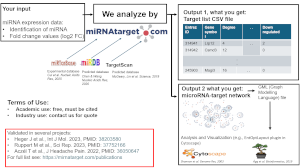
Detailed workflow